A new comprehensive religious forensics investigation reveals two stunning conclusions:
- The stories in Genesis are cartoonish rewrites of much older Mesopotamian literature.
- The rewrites are designed to cast human ideals as sins.
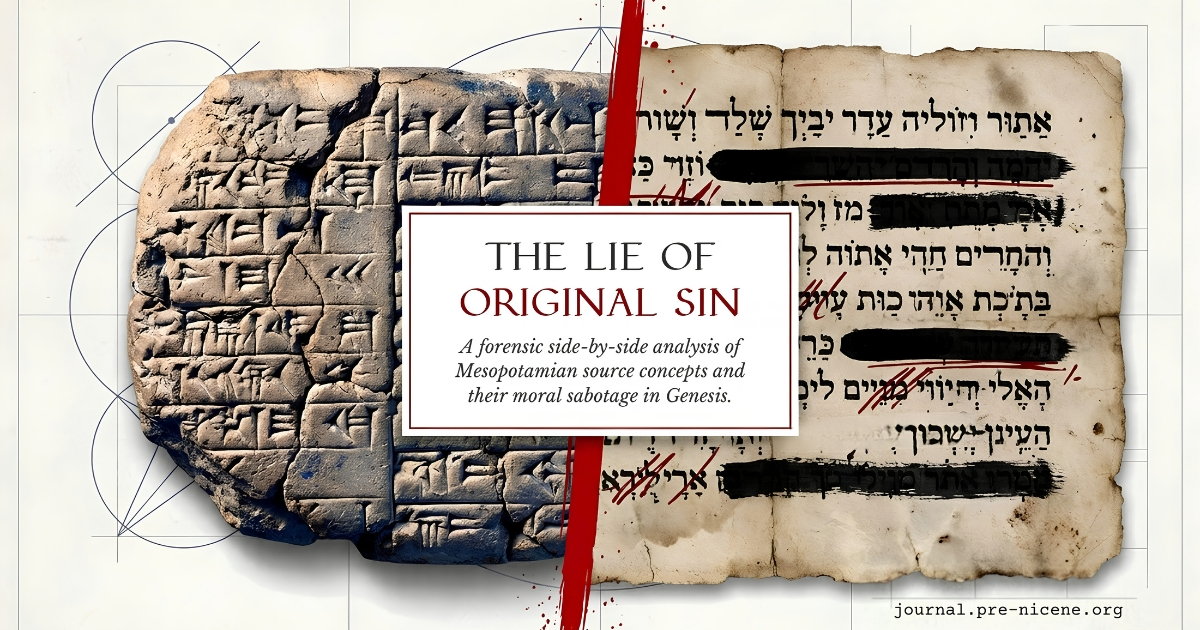
Abstract: On 3 December 1872, before a packed assembly of the Society of Biblical Archaeology - the sitting Prime Minister, William Ewart Gladstone, among the political and ecclesiastical dignitaries - the self-taught cuneiform decipherer George Smith read his translation of Tablet XI of the Epic of Gilgamesh. When he reached the bird sequence of the Babylonian deluge, the room fell into stunned silence: the Noah narrative of Genesis was not a unique, pristine revelation delivered to Moses at the dawn of time but an adaptation of a pagan Mesopotamian blueprint written centuries earlier. This paper argues that the flood was only the first front of a larger operation. The foundational narratives of Genesis - the Garden, the Flood, Babel, the birth of Moses - are a systematic appropriation of older Mesopotamian literature (Gilgamesh, Atrahasis, Adapa, the Sargon legend, the Code of Hammurabi), executed not by copying alone but by moral inversion: the knowledge, self-awareness, technology, and civic life that Mesopotamia celebrated as human ascent are recast as cosmic crimes, and natural mortality is recast as inherited guilt. That inversion - the doctrine of Original Sin - is the initiating anomaly of the present investigation.
Building on the forensic model of the Theophanic Replacement Protocol 1 and the archival reversal of Marcionite priority 2, and reading the Psalter, the Ugaritic archive uncovered at Ras Shamra from 1929, and the Deuteronomy 32:8 witness tradition as further fronts of the same operation, the study models the transmission of the engineered text as a cultural pathogen - the text-virus - whose germline reservoir was the Shasu nomads of the Egyptian records, whose somatic hosts were the populations of Canaan and then the Mediterranean, and whose mutation into the Yahwist synthesis was answered by a primitive counter-text. Marcion of Sinope’s Evangelion and Apostolikon (144 AD) are not a mutilation of canonical Luke but the earlier stratum; Luke is the Judaized expansion. Marcion emerges not as the archivist’s heretic but as the archivist of the antidote.
JPCS September, 2026
https://www.journal.pre-nicene.org/JPCS-September-2026.html
Listen to a discussion of the paper.
Download the PDF with academic slides
